The starting arrangement
Right-hand table is home, in the 1909 plate
Hoyle does not ask you to invent a layout. Fig. 1, and the paragraph that names the tables, still tell you where every man stands.
Tap a point to see what starts there
Right-hand table = inner / home, as in Hoyle’s Fig. 1
The starting arrangement is described below.
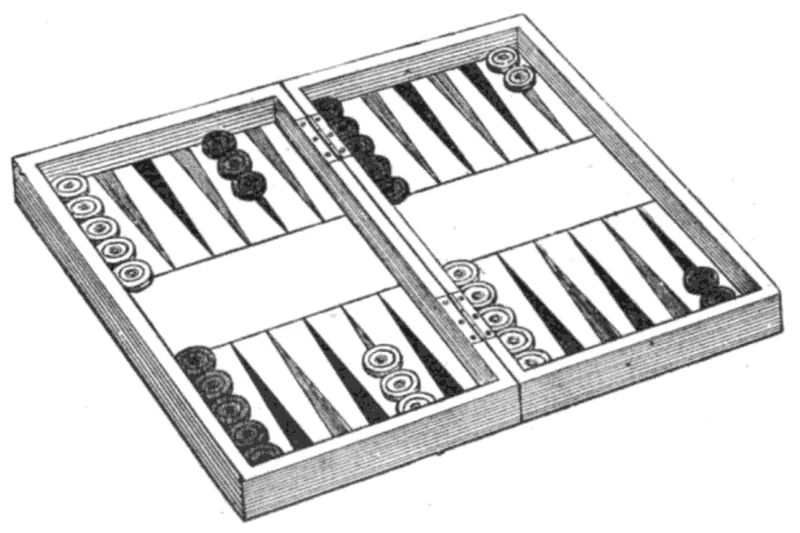
The official 1909 placement is easy to say aloud, and worth saying slowly. “Two of White’s men are placed on the ace point in Black’s inner table, five are placed on the six point in Black’s outer table, three on the deuce point in White’s outer table, and five on the six point in White’s inner table. Black’s men are placed in like manner on the points immediately facing these.” [source]
The names of the points have a period flavour that the book itself helps you pronounce. Trois, quatre, cinque and six, a footnote says, are “pronounced tray, kater, sank, and size, respectively.” [source] The ace point in the outer table “is more commonly known as the ‘bar’ point.” [source]
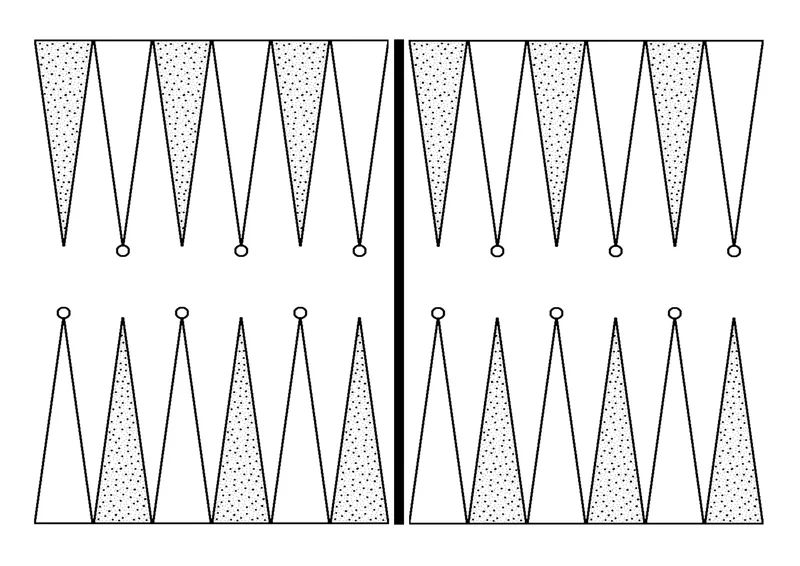
Anna Frodesiak’s empty diagram is useful precisely because it is empty. It is “printable, and educational,” as the file says, and it is not a starting arrangement. The men have to be placed, officially, before the first die is thrown.
Who throws that die? “Each player throwing on the centre of the board a single die, the higher throw of the two giving the right to begin.” A tie is thrown again. “The thrower of the higher number may either adopt the points shown by the two dice as his own throw, or throw again.” After that, “all subsequent throws are with both dice.” [source] The 1911 article tells almost the same official opening story. [source] Neither page is treated here as today’s tournament custom. The World Backgammon Federation’s tournament-rules PDF was still blocked on 18 November 2026, and is not used to “update” Hoyle.
Hoyle’s official first throws
Because both sides start in a uniform position, the 1909 chapter then walks, “seriatim,” through every first throw, sometimes with a safer line “for a hit” and a bolder one “for a gammon.” [source] The official best opening throws, “at the outset of the game,” are double aces, then double sixes, then double trois, then trois ace and six ace.
Aces. “The best possible throw at starting.” Play two men on your bar point, and two on your cinque point. [source]
Deuce ace. For a hit, play the deuce from the five men in your adversary’s outer table, and the ace from the ace point in his inner table. For a gammon, play the ace from the six to the ace point in your own table. [source]
Deuces. For a hit, play two from the six to the quatre point in your own table, and the other two from the ace to the trois point in your opponent’s inner table. For a gammon, play the second pair from the five men in his outer table. [source]
Trois ace. “Make your cinque point.” [source]
Trois deuce. “The approved play is to carry two men from the five in your adversary’s outer table to the quatre and cinque points in your own outer table. This, of course, makes two blots.” To avoid that, some players, for a hit, play one man from the same point to the deuce point in that table, “but the bolder play is to be preferred.” [source]
Double trois. Some players make the bar point. The more usual play is, for a hit, to play two to the cinque point in the player’s own, and the other two to the quatre point in the adversary’s table. For a gammon, play the last two from the six to the trois point in your own table. [source]
Quatre ace. Play the quatre from the five men in your opponent’s outer table, and the ace from his ace point. Timid players, “fearing to leave two blots, sometimes play the whole throw from the first-mentioned point, but the plan is not to be recommended.” [source]
Quatre deuce. “Make your quatre point.” [source]
Quatre trois. Play two men from the five in your adversary’s outer table. [source]
Double quatre. Play two men from the ace to the cinque point in the adversary’s inner table, and two from the five in his outer table. For a gammon, play two men only, from the point last mentioned to the cinque point in your own table. [source]
Cinque ace. Play the cinque from the five men in your adversary’s outer table, and the ace from the ace point in his inner table. For a gammon, play the ace from the six to the cinque point in your own table. [source]
Cinque deuce. Play both men from the five in your adversary’s outer table. [source]
Cinque trois. “Make your trois point.” [source]
Cinque quatre. Move one man from your adversary’s ace point to the trois point in his outer table. [source]
Double cinque. Carry two men from the five in the adversary’s outer table, and make your trois point. [source]
Six ace. “Make your bar point.” [source]
Six deuce. Move a man from the five in your adversary’s outer table to the cinque point in your own table. [source]
Six trois, six quatre, six cinque. “Carry one man from your adversary’s ace point as far as the throw will permit.” [source]
Sixes. “Place two men on your adversary’s bar point, and two on your own.” [source]
Those are 1909 directions for the first throw, not a modern coaching app, and not a tournament card. They belong with the plate. For what happens once a blot is left, see how the men move.
Enjoyed this desk of a 1909 starting arrangement, three official scores, and related games that are not the same game?
No pop-ups. No intrusive advertising. Just interesting stuff. A little support helps the next learntoplay.im site get built.