How the men move
Making a point, leaving a blot, and beginning again
The pleasure of the game, in every official account on this desk, is that a man can be sent back. The official names for that misfortune are older than any app.
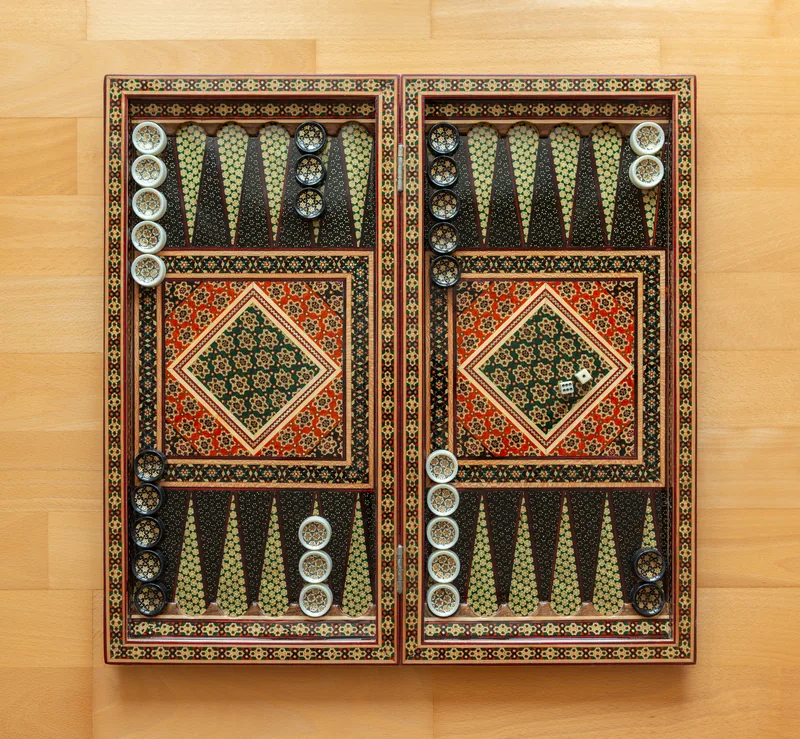
From the ace point in the opponent’s home table, Hoyle says, each player’s men move toward the like point in his own. “The number uppermost on each die entitles the player to move one man forward a corresponding number of points.” A throw of “six trois” may be used on one man or on two, and doublets are “played twice over.” [source] The 1911 article agrees that double sixes, for example, allow “four moves of six points,” “either all by one man or separately by more.” [source] Britannica’s captured wording says the same idea in its own official sentence: “doublets are taken twice over (two 6s count as four 6s).” [source]
The right to move, though, has a gate on it. “A man can only be played to a point which is either vacant or occupied by one or more men of the player, or by one man only of the adversary.” Two men “make” the point. A single man is a “blot.” [source] Britannica, in the captured wording, uses “stones” for the same official idea: a point with two or more stones is “made,” and a single stone is a “blot.” [source] The words are not rewritten into one another.
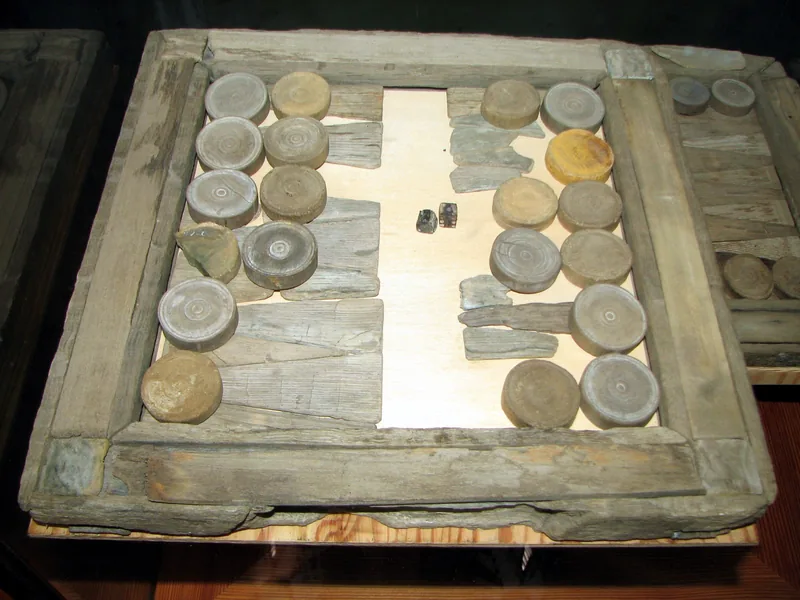
If a blot is hit, Hoyle says it is “taken up” and placed on the bar, and “however far advanced it may have been, has to begin its journey anew from the inner table of the adversary.” Until that man re-enters, “the play of his other men is suspended.” [source] The 1911 article is just as firm: “A player is not allowed to move any other man while he has one to enter.” [source] The World Backgammon Federation’s captured wording tells the same modern story with “checkers”: a hit sends a single opposing checker to the bar, and it must re-enter through the opponent’s home board before any other move. [source]
If the opposing home table is completely closed — each point occupied by two or more men — Hoyle says the player who has a man to enter is “altogether suspended,” and the adversary goes on throwing “until the course of play again throws open one or more points.” [source]
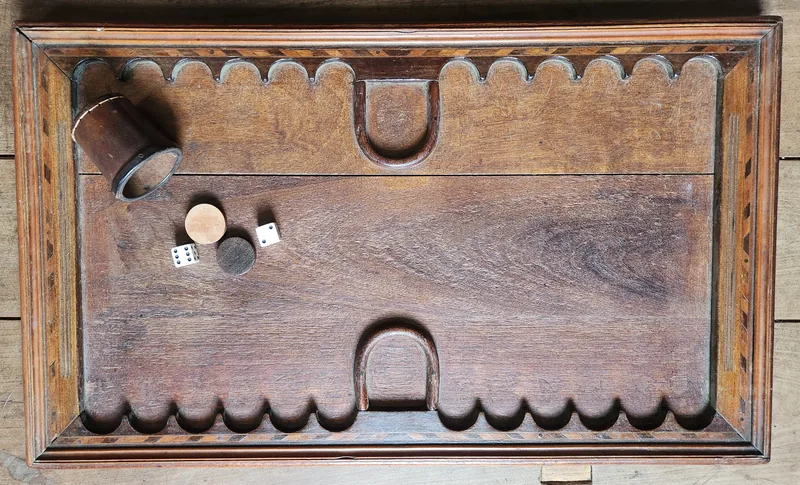
Bearing off begins only when all of a player’s men are in his home table. Then each throw may move a man inside that table, or take a man off the corresponding point. If the point is empty and the throw cannot be used in either of those ways, Hoyle entitles the player “to bear off a man from his highest occupied point.” [source] The 1911 article adds a warning that still has a sting: if, after bearing has begun, you are hit, “you must enter on your adversary’s inner table and must bring the man taken up into your own inner table before you can bear further.” [source]
The first player to remove all his men wins. What that win is worth is a different official question, and lives on the score page. A short quiz and a timeline sit beside this lesson, still on official wording.
Enjoyed this desk of a 1909 starting arrangement, three official scores, and related games that are not the same game?
No pop-ups. No intrusive advertising. Just interesting stuff. A little support helps the next learntoplay.im site get built.