A game of points, and of being sent back
The starting arrangement, and three official ways to finish
Fifteen men each, twenty-four points, and a pair of dice. A 1909 book still tells you exactly where the men stand at the start. Later official pages then disagree, politely, about what a backgammon is worth.
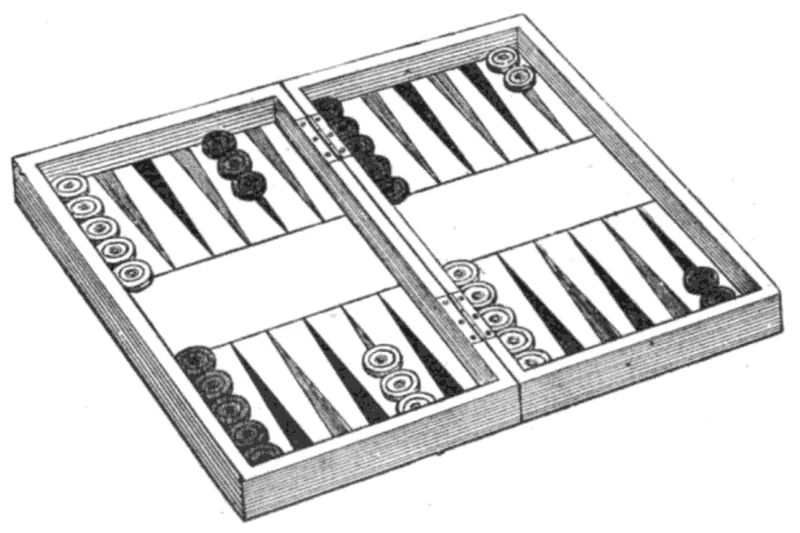
Open Hoyle’s Games Modernized at the backgammon chapter, and the first thing you meet is a plate. The official caption is simple: “Backgammon: starting arrangement.” [source] The text that goes with it is careful about the room you are sitting in. “With the men placed as in Fig. 1, the right hand is the inner or home table.” [source] That 1909 sentence is why the desk on the starting arrangement page treats the right-hand table as home, and why this site does not quietly swap the board around to match a later habit.
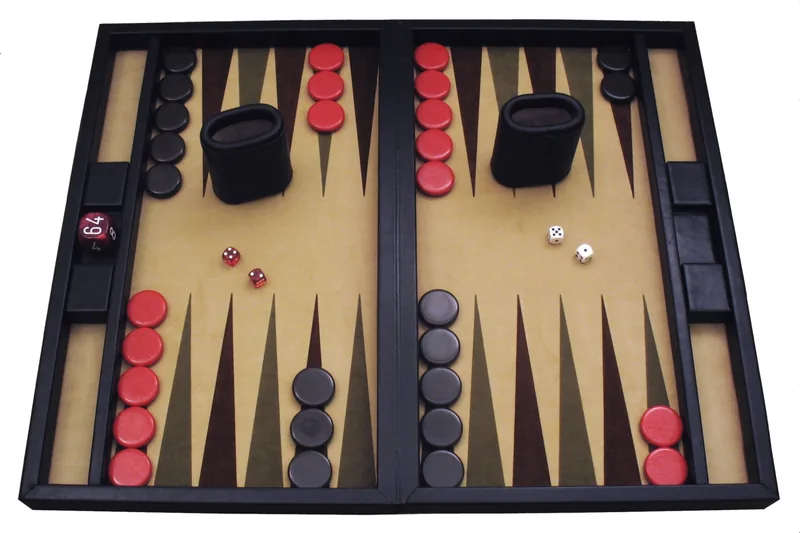
A modern set, like the one in Ptkfgs’s 2007 photograph, may arrive with a cube as well as dice. The World Backgammon Federation, in wording captured on 16 November 2026, does list that cube, marked 2, 4, 8, 16, 32 and 64, among the official equipment. [source] Hoyle’s 1909 apparatus list is shorter: “A pair of dice (or sometimes a pair for each player) and a couple of dice-boxes complete the apparatus of the game.” [source] Both official lists are kept. This desk explains the cube, and does not offer you a bet.
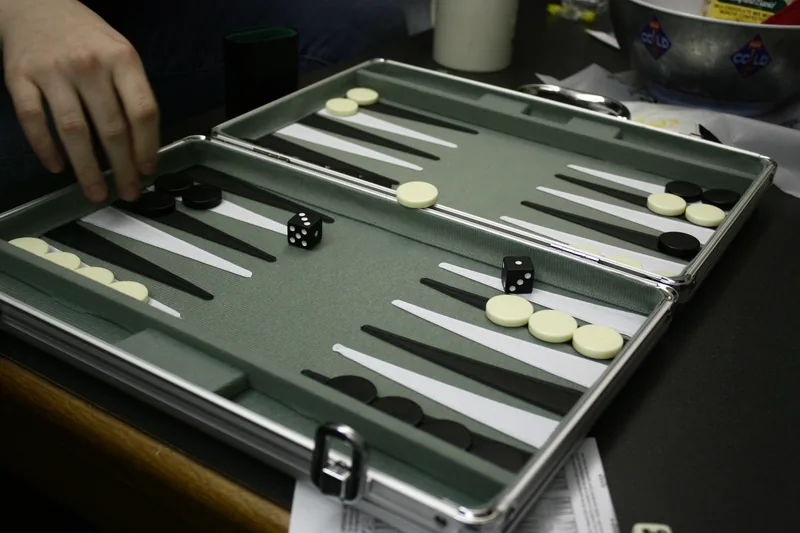
The interesting work, once the men are placed, is official movement: making a point, leaving a blot, being hit and sent to the bar, then bearing off when everyone is safely home. [source] [source] After that comes the score, where a hit, a gammon and a backgammon are not quite the same sentence on every official page. The score desk lets Britannica, Hoyle and the 1911 article sit side by side.
Enjoyed this desk of a 1909 starting arrangement, three official scores, and related games that are not the same game?
No pop-ups. No intrusive advertising. Just interesting stuff. A little support helps the next learntoplay.im site get built.