The score
A hit, a gammon, and a backgammon that is not quite the same sentence twice
Three official accounts agree that a gammon counts double. They do not quite agree on what a backgammon is worth, or on every condition that makes one.
How far had the loser got?
Choose how the game ended.
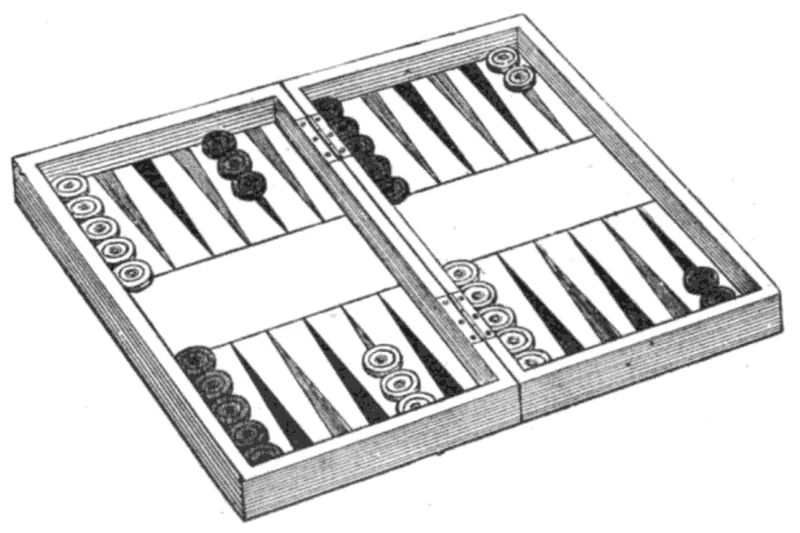
Hoyle’s 1909 valuation is a little story of how far the loser had got. If the adversary “has got all his men into his own home table, and has begun to bear off, the game of the winner is known as a ‘hit.’” If the winner “has borne off all his men before his adversary has begun to do the same, the game is known as a ‘gammon,’” and the loser “pays double the agreed stake.” If the winner has borne off all his men “while the adversary has still a man or men ‘up’ (i.e., on the bar) or in his (the winner’s) home table, the game is a ‘backgammon,’ and the loser pays either thrice or four times (as may have been agreed) the amount of the single stake.” [source]
The 1911 Encyclopaedia Britannica tells a close official story, and then uses a firmer multiplier. The first player to take off all his men wins “a single game (a ‘hit’) if his adversary has begun bearing; a double game (a ‘gammon’) if the adversary has not borne a man; and a triple game (a ‘backgammon’) if, at the time the winner bears his last man, his adversary, not having borne a man, has one in the winner’s inner table, or has a man up.” [source] “Triple” is the 1911 word. “Thrice or four times, as may have been agreed,” is Hoyle’s. They are both official, and they are not combined here into a single modern stake.
Encyclopaedia Britannica, in wording captured on 16 November 2026, uses “stones,” and is a little narrower about the backgammon. If the loser “has borne off at least one stone, the game is a single”; if none, “a gammon (double)”; “if in addition the loser has a stone left in the winner’s inner table, a backgammon (triple).” [source] That captured sentence does not, on its own, mention a man still “up” on the bar as a way to make a backgammon. Hoyle and the 1911 article both do. The difference is left visible.
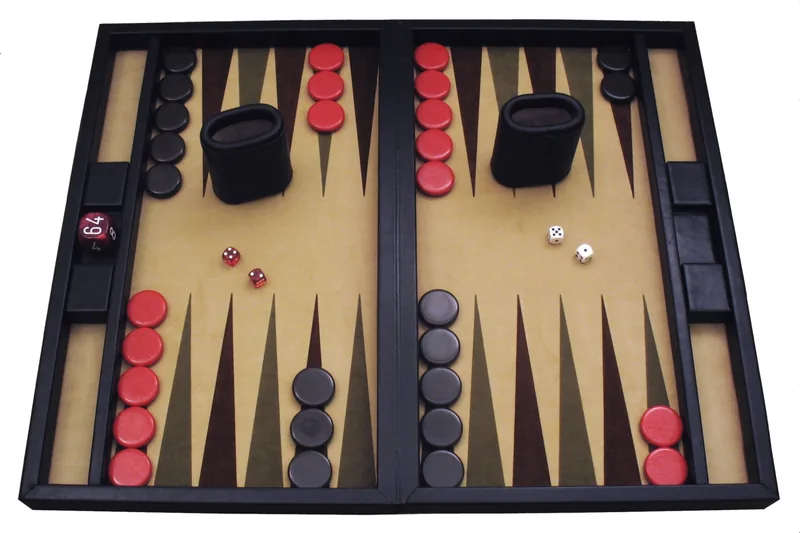
The doubling cube is a different official object again. The World Backgammon Federation’s captured wording says a player “may propose to double the stakes, and the opponent may accept or give up,” and that the cube is marked 2, 4, 8, 16, 32 and 64. [source] Hoyle’s 1909 apparatus list does not mention it. This desk explains the official cube, and does not take a rake.
After the game, the next first throw is also official. Hoyle: the winner of a hit throws first in the game that follows; after a gammon or backgammon, the players throw again for the right to begin, as at starting. [source] The 1911 article agrees on the hit, and says that if a gammon is won, “the players each throw a single die to determine the first move of the next game.” [source]
Enjoyed this desk of a 1909 starting arrangement, three official scores, and related games that are not the same game?
No pop-ups. No intrusive advertising. Just interesting stuff. A little support helps the next learntoplay.im site get built.